- L&D INSIGHTS/
- UK Training Demand Report 2026: What Organisations Actually Buy/
- L&D INSIGHTS/
- UK Training Demand Report 2026: What Organisations Actually Buy/
UK Training Demand Report 2026: What Organisations Actually Buy
Every number in this report comes from Future Savvy's own records: 1,451 completed training orders from UK organisations between January 2019 and October 2026, the job titles and employer sizes of the people who placed them, 229 post-course reviews, and 391,289 Google search impressions on this site over the 90 days to 7 October 2026. Where we quote a public figure we name the source. Nothing here is a survey of intent; it is what organisations actually paid for, which is a different and in our experience more honest signal.
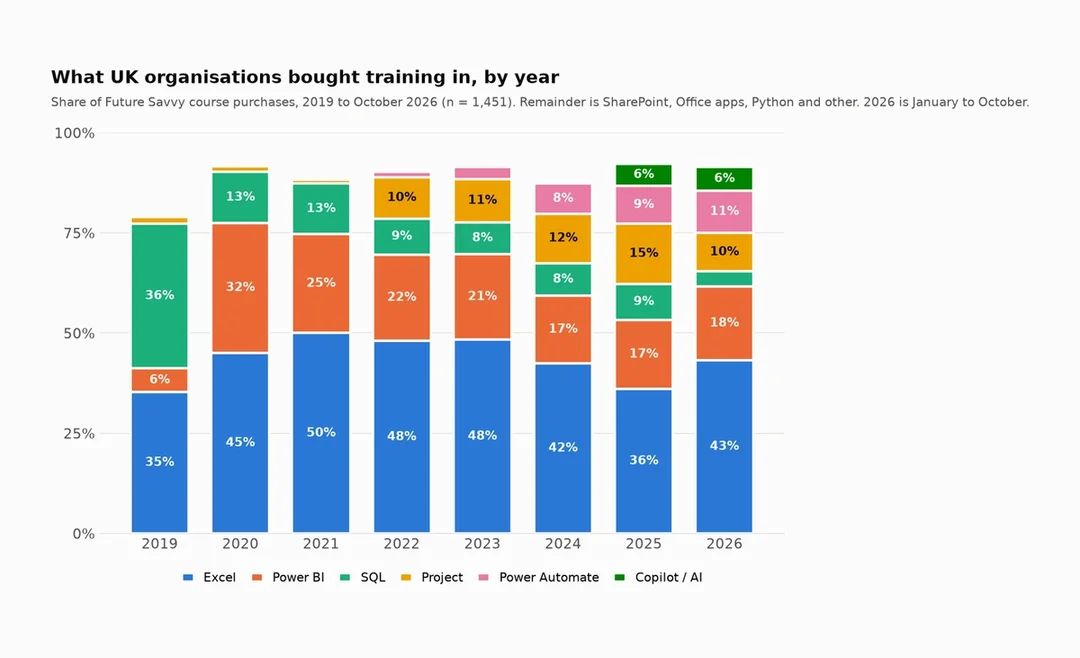
Summary: Excel is 44% of everything bought over seven years and still 43% in 2026. Power BI settled at a fifth of orders after a 2020 spike. SQL has fallen from a third of orders in 2019 to under 4% this year. Power Automate went from nothing to one order in ten. Copilot and AI training appeared in 2025 and is 6% of 2026 orders. Two in five orders are placed by someone in L&D or HR, and half of buyers work for organisations with more than 500 staff.
What organisations buy, by year
Excel has been the single biggest line every year, never below 35% and as high as 50% in 2021, the year most office work moved home and spreadsheets became the shared language of remote teams. It was 43% of orders in 2026. Anyone who expected Excel training demand to fade as BI tools spread has been wrong for seven consecutive years.
Power BI jumped from 6% of orders in 2019 to 32% in 2020 and has settled between 17% and 25% since. The 2020 spike was first-time adoption; what has followed is steadier, and increasingly Intermediate-level: teams that already have reports and want to make them trustworthy.
SQL is the clearest decline in the data. It was 36% of orders in 2019, more than Excel, and is 3.8% in 2026. Our reading is not that fewer people need to query data; it is that the people who used to learn SQL to get at it now reach it through Power Query and Power BI instead.
Power Automate went from zero orders before 2021 to 11% of 2026 orders, overtaking SQL in 2024. Microsoft Project climbed from 2% to a steady 10 to 15% from 2022, as public-sector and construction clients standardised on it. Copilot training did not exist in our order book until 2025 and is 6% of 2026 orders, almost all of it private team sessions rather than public seats.
What a training purchase costs
The median Excel order is £550, which is one or two people on a public course. The median Power BI order is £1,290 and SQL £1,590, because those are more often a private day for a team. Python, at £2,990, is almost entirely private multi-day engagements. The pattern is consistent: the more specialist the tool, the more likely an organisation is to train a whole team at once rather than send one person.
Public scheduled courses outnumber private team bookings roughly two to one by count (156 to 73 in 2024, 148 to 83 in 2025) but private bookings carry most of the value, because a private day trains six to twelve people for a single fee.
Who places the order
Of 2,258 buyer contacts with a usable job title, 42% work in learning and development or HR. The next largest group, at 11%, is operations and office management: the person who runs the team and has noticed the spreadsheet problem themselves. Directors and heads of department are 9%. IT and data roles are only 4%, which surprises people: Excel and Power BI training is bought by the business, not by IT.
Half of buyers (52%) work for organisations with more than 500 staff, and 31% for organisations over 1,000. By sector, the two largest groups are education management (14%) and higher education (12%), followed by hospitals and health care (8%) and construction (4%). Universities, NHS trusts and councils buy more Excel training than any private-sector group, partly because they have the most staff doing reporting in Excel and partly because they have the budget lines to pay for it.
What people search for versus what organisations buy
Excel is 91% of the 391,289 Google impressions this site received in the 90 days to 7 October 2026, and 44% of what organisations buy. Power BI is 2% of search and 19% of purchases. SQL barely registers in search and is 11% of purchases. The gap is the difference between an individual with a formula problem at 3pm and a manager deciding what the team needs. Individuals search for Excel answers; teams get bought Power BI and SQL training by someone who has already decided.
What delegates say afterwards
229 delegates have left a rating published on this site since mid-2025, on a five-point scale. The mean is 4.79, 50% gave five, and 85% gave 4.5 or more. Reviews.io, which collects every rating we receive, holds 696 across all years at 4.7; the 229 are the ones published on this site, and the two populations are not the same set. The most-reviewed courses are Power BI Introduction, Excel Introduction and Excel Intermediate, which matches the order book. We publish every review, including the three-star ones.
The wider UK picture
Our data is one provider's order book. The national figures point the same way. FutureDotNow and the Centre for Economics and Business Research reported in 2025 that 52% of UK working-age adults cannot complete all 20 digital tasks industry and government agree are essential for work, and that closing that gap would add more than £23 billion a year to UK gross value added. In no UK region can more than half the workforce complete all 20 tasks. One in five people working in the tech sector cannot.
The Department for Education's Employer Skills Survey 2024 found 14% of Scottish employers had staff not fully proficient in their role, rising to 42% of employers with 100 or more staff. Among the digital skills employers said were lacking, basic Microsoft Office skills were named by 23% and advanced Microsoft Office skills by 12%. The House of Commons Library's 2024 briefing on digital skills cites a government estimate that the digital skills gap costs the UK economy £63 billion a year, and research finding 46% of businesses had struggled to recruit for roles requiring hard data skills.
Skills England's 2026 annual report says employers report more than a quarter of vacancies are hard to fill because of skills shortages, that business investment in training has been declining over the long term across most sectors, and that the education pipeline alone will not meet demand, so significant reskilling of the existing workforce will be essential. That last sentence is, in practice, what the 1,451 orders above are.
Method and sources
Purchase data: 1,451 closed-won deals in Future Savvy's CRM, placed between 1 January 2019 and 9 October 2026, each assigned to one topic by the course named on the order. Two of them, placed in late September for November course dates, carry CRM close dates of 22 and 29 October 2026 and are included in the count. CRM records begin in January 2019; Future Savvy and its predecessor Systematix have delivered training since 1982, so this window covers the most recent seven years, not the company's history. Orders naming no recognisable topic (4.6%) are counted in the total but not in any topic. Median order values are ex VAT. Buyer role and employer size are from the CRM contact record on the order, and only contacts with that field populated are counted (role n = 2,258, size n = 763, sector n = 1,152). Search data: Google Search Console for futuresavvy.co.uk, 10 July to 7 October 2026, impressions grouped by the tool named in the query. Reviews: all 229 delegate ratings published on this site as at 9 October 2026; Reviews.io, which collects every rating, holds 696 across all years.
External figures: FutureDotNow and Cebr, The Economic Impact of Closing the Workforce Essential Digital Skills Gap, May 2025. Department for Education, Employer Skills Survey 2024 (Scotland chapter, published October 2025). House of Commons Library, Digital skills and careers, CDP-2024-0073. Skills England, Annual Skills Report 2026.
This report is updated each October. You are welcome to quote any figure with a link to this page. For the underlying tables, email hello@futuresavvy.co.uk.
Find your level
If you are deciding what to buy for a team, the fifteen-question Excel self-assessment places each person in two minutes and the formulas cheat sheet is the free reference most delegates ask for on the day.
Take the Excel skills self-assessmentExcel formulas cheat sheetSee our Excel training coursesNext available dates
Excel Intermediate
Live, instructor-led training with a real trainer. Book a seat on a scheduled date below, or get a quote for your team to run it privately.
10 Nov 2026
Tuesday · Virtual · 1 day
£325per person + VAT
7 Dec 2026
Monday · Virtual · 1 day
£325per person + VAT
Other courses related to this article
- Microsoft Power BIPower BI IntroductionThis 2-day introduction to Power BI gives beginners the confidence to analyse business data and build clear, effective visual reports. With hands-on guidance, you’ll learn practical skills using real-life data, quickly becoming comfortable with core Power BI functions that make work easier and more insightful.2 Days · Classroom or on-site
- Microsoft ExcelExcel AdvancedAdvance your Excel skills in this one-day course, designed for those already comfortable with spreadsheets. Gain practical tools for automating tasks, handling complex datasets, and visualising results, so you can analyse and present data with ease for your team or organisation.1 Day · Classroom or on-site
Ready to train your team?
Tell us what you need and we'll come back to you with a detailed quote.
- Tailored contentBuilt around your team's work and skill levels.
- Flexible schedulingDates and times that suit your team, not ours.
- Your place or onlineDelivered at your office or virtually.
- Better value per headOne trainer, one day, your whole team.
- A dedicated trainerYour team gets all of the trainer's attention.
- Realistic examplesSample data built around the kind of work your team does.
We reply with available dates and a price for your team. No obligation.
Frequently Asked Questions (FAQ)
Prompting, verification, workflow design, automation, and responsible AI use.
No. These skills apply across functions, from admin and marketing to finance and operations.
Clear examples of how you used AI to save time, improve quality, or support better decisions.
Begin with your current tasks, test AI on repeat work, and track the results.
Related Articles
 L&D Insights
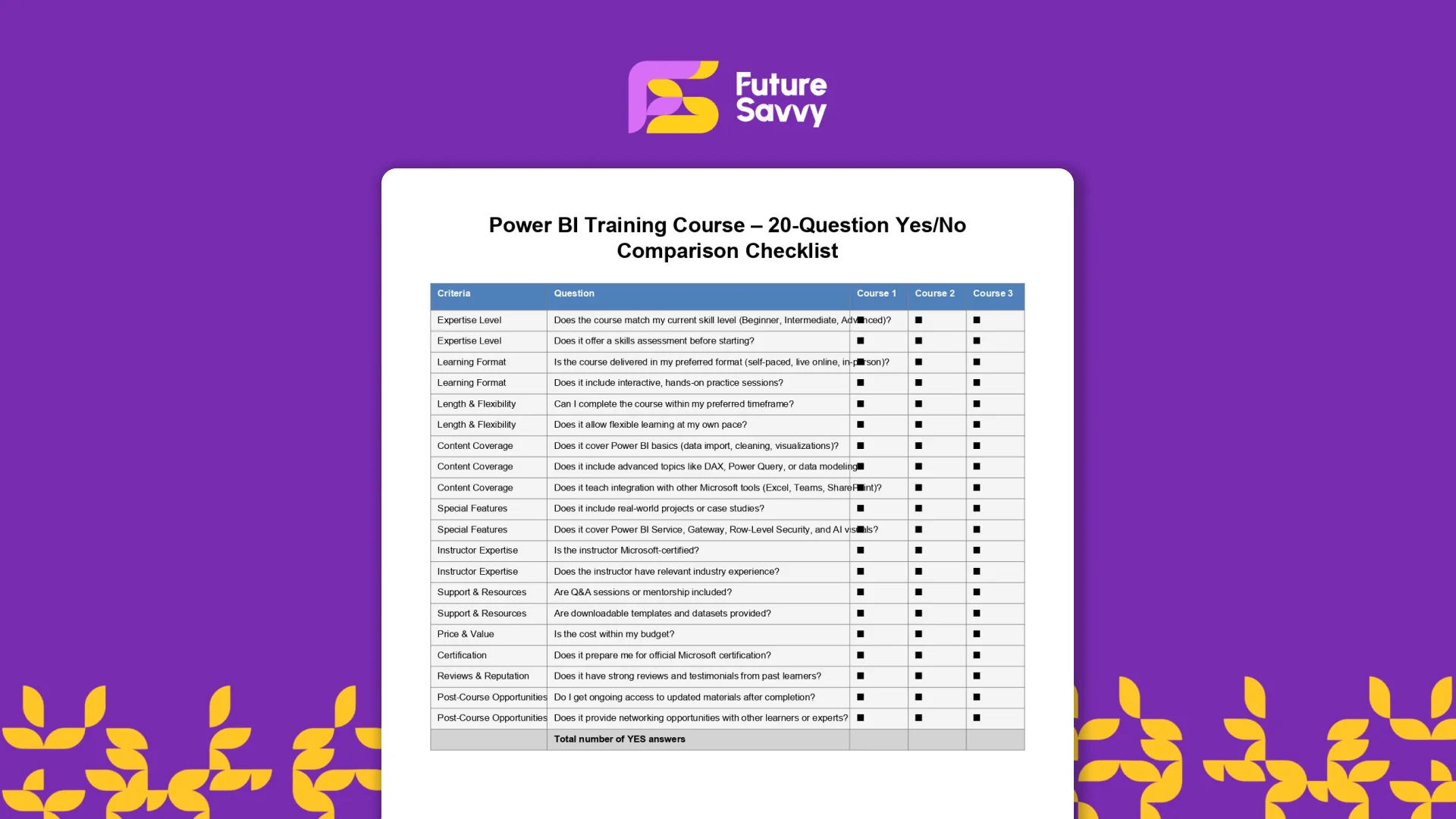
Power BI Training Course – 20-Question Comparison Checklist
The Power BI Training Course – 20 Questions Checklist is a practical, printable tool to compare Power BI courses across providers objectively. Use it to score curriculum quality, delivery format, hands-on practice, certification prep, and after-course support so you can choose with confidence.
 L&D Insights
Basic vs. Advanced SQL Training Courses: What is the difference?
The article explains what SQL training courses cover at basic and advanced levels, highlighting their shared focus on hands-on practice. It contrasts beginner courses that teach core querying and database concepts with advanced courses that tackle complex joins, window functions, CTEs, indexing, and performance. It outlines certifications, career paths, and why SQL remains a high-demand skill across roles like analysts, engineers, and developers. Finally, it offers criteria for choosing the right course and showcases instructor-led options from providers such as Future Savvy and others.
 L&D Insights
Literacy vs Digital Literacy: What Are the Differences?
Traditional reading-and-writing literacy has broadened into digital literacy—the ability to locate, evaluate, create, and communicate information safely and effectively through technology. The article traces this evolution from basic “computer literacy” of the 1990s to today’s multifaceted concept that spans information, media, and AI literacy. Digital skills now underpin social inclusion, workforce readiness, and democratic participation, while gaps in access, competence, and support exacerbate inequality.
Insights for modern teams
Stay ahead with our latest learning trends, tools, and success stories. Enter your email address below to receive updates from us.