- L&D INSIGHTS/
- AI for Managers: A Guide/
- L&D INSIGHTS/
- AI for Managers: A Guide/
AI for Managers: A Guide
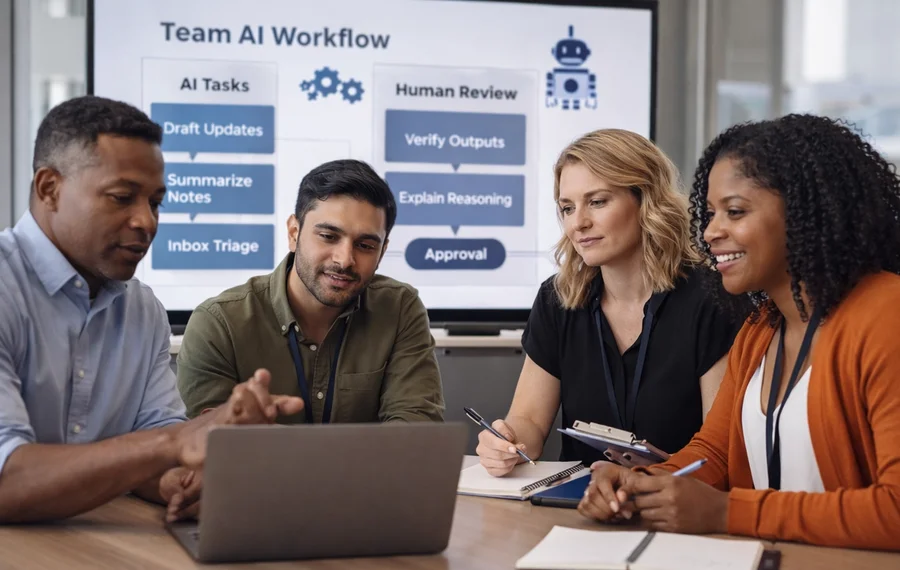
AI is no longer a side project owned by IT or innovation teams. It now shows up in the tools your people use to write emails, capture meeting notes, triage inboxes, plan schedules, and analyse performance data. Executives are already experimenting, talking about digital “team members”, and expecting tangible returns in months, not years.
Recent surveys suggest senior leaders use AI significantly more than their own staff, which means middle managers are the ones being asked to turn that enthusiasm into working reality while also closing the usage gap in their teams.
The real bottleneck is not access to AI tools; it is the absence of clear use cases, norms, and guardrails. Teams are unsure when to rely on AI, when to challenge it, and how it will affect workloads, learning, and performance expectations.
At the same time, routine managerial tasks are being automated, while the demand for judgement, coaching, and coordination is rising. As one leadership adviser puts it, AI is “coming for managerial tasks, but not for human leadership”.
This guide is for managers of knowledge workers and mixed or hybrid teams, regardless of technical background. It focuses on:
- Concrete, low‑jargon use cases for planning, coaching, performance, communication, and workflows
- Day‑to‑day leadership behaviours that make AI useful rather than stressful
- Practical steps to introduce AI responsibly, aligned with your organisation’s policies and legal guidance
You do not need to become a data scientist. You do need to become an effective orchestrator of people and AI.
Getting oriented: What AI means for your role
AI has moved from side project to everyday infrastructure. For managers, it is less about “cool tech” and more about how work actually gets done. In many large firms, senior leaders already see AI as a near‑term performance lever: recent research with global executives found they are adopting AI at significantly higher rates than managers and employees, and expect clear returns within the next few years, which inevitably translates into pressure on middle management to turn ambition into practice.
From tools to teammates: what AI actually is in a management context
In practical terms, AI is a set of systems that:
- recognise patterns in data
- generate content (text, images, code, summaries)
- make recommendations or take actions based on rules and history
Two flavours matter most for managers:
- Generative AI – a drafting partner that helps you and your team produce first versions of plans, emails, reports, training materials or analyses. Senior leaders at companies like Cisco and Walmart already use it this way, treating AI as a research aide, writing assistant and communication coach rather than an autopilot
- Agentic AI – a digital colleague that can act within defined bounds: scheduling meetings, filing tickets, updating CRMs, drafting follow‑ups, or routing work. As Finextra notes, these agents behave less like static tools and more like “digital co‑workers” that plan, move across systems and deliver end‑to‑end outcomes within constraints you set.
You are still accountable. The shift is that more of the “typing and tracking” can be done by machines, while people focus on interpretation, decisions, and relationships.
The “hourglass” effect and the evolving middle‑manager role
As AI absorbs routine, mid‑skill tasks like reporting, status updates, and basic coordination, some organisations are trimming management layers. Survey data from large companies already points to an “hourglass” structure: bigger at the top and bottom, thinner in the middle, with CEOs expecting AI agents to become “embedded team members” that require human oversight rather than constant human orchestration.
That does not automatically mean your role disappears; it means it changes.
Your work tilts away from:
- checking tasks, chasing updates, collating data
and towards:
- designing workflows where AI handles the repeatable steps
- deciding when humans must review, override, or escalate
- translating top‑down AI ambitions into clear, local practice
Think of yourself less as a traffic warden and more as an orchestrator of a mixed human–AI team.
Where humans stay essential
Even very capable AI is brittle in messy, human situations. Your unique value concentrates in three areas:
- Judgement and trade‑offs – weighing ethics, customer impact, long‑term risk, and reputational issues where there is no “right” answer in the data. Management thinkers increasingly describe this as becoming an “ethical decision‑maker at scale”, steering thousands of micro‑decisions that AI surfaces but cannot own.
- People leadership – building trust, handling conflict, motivating individuals, and protecting psychological safety when change and anxiety are high. As one commentator on AI and leadership puts it, “AI is coming for managerial tasks, but not for human leadership”; the emotional climate, culture and cohesion of the team remain firmly human responsibilities
- Cross‑functional sense‑making – connecting AI‑generated insights across teams, spotting contradictions, and aligning decisions with strategy and culture.
AI can flag patterns; it cannot own the consequences. That remains your job.
A simple mindset shift for managers
Instead of asking, “How do I use this new tool?”, start asking:
“Which parts of this workflow should be done by AI, which by humans, and why?”
For any recurring activity, you are aiming to clarify:
- what AI can do reliably
- what AI should not do because of risk, nuance, or learning value
- how people and AI will review each other’s outputs
Regulators and industry bodies are beginning to formalise this kind of thinking. The UK Financial Conduct Authority, for example, treats AI not as a single model but as an end‑to‑end system, emphasising clear human‑in‑the‑loop points, governance, and live testing in real workflows rather than endless pilots.
The rest of this guide will apply that lens to your core responsibilities: planning, coaching, performance, communication, and designing team workflows, so you can adopt AI at a sustainable pace without overwhelming your team.
Turning executive ambition into a team‑level AI plan
Executives are treating AI as an urgent priority and expect visible returns within months, not years – in one recent survey, nearly 70% of CEOs anticipated pay‑offs within one to three years, with a growing minority looking for returns inside 12 months. Yet many teams only see scattered pilots and mixed messages. Your job is to turn that ambition into a simple, practical plan your team can execute without anxiety or confusion.
Close the strategy–execution gap
Most employees are not blocking AI; they are waiting for clarity. Large workforce surveys show the real issue is often the absence of a clear, local plan and guidelines, even when corporate AI announcements have been made. The main barrier is the absence of a coherent, local plan:
- What AI is for in this team
- Where it will and will not be used
- How success and “good use” will be judged
Start by translating top‑down goals into three or four plain statements for your team, such as “reduce admin load in case handling” or “improve forecasting accuracy for project risks”. This anchors AI in their reality rather than in abstract innovation slogans, and matches what data leaders describe as the manager’s emerging role: designing human–AI workflows rather than simply “rolling out tools”.
Start with your team’s work, not with tools
Avoid starting from a shiny platform. Begin with work:
1. List 3–5 core workflows (for example, sales pipeline, sprint planning, incident response, month‑end reporting).
2. Break each into steps and mark:
- AI‑can steps: high‑volume, repeatable, pattern‑based tasks (inbox triage, meeting notes, first‑draft updates, simple data look‑ups).
- AI‑should steps: areas where AI could materially improve performance (risk spotting in project plans, scenario planning using historical cases, demand forecasting).
- Human‑only steps: judgement calls, nuanced prioritisation, sensitive conversations, performance decisions, complex negotiations.
This mirrors how leading firms now approach “workflow redesign” around AI: they look at end‑to‑end journeys, rather than sprinkling automation on isolated tasks. Research on AI value creation in financial services, for example, finds that re‑engineering entire processes (such as lending or onboarding) drives far larger gains than merely accelerating one review step.
Keep a visible map of this. It helps the team see AI as a collaborator, not a threat, and makes it easier to phase in changes.
Define clear use cases and decision rights
Next, co‑design a small, safe set of pilots:
- Chooe 3–5 high‑friction, low‑risk use cases (for example, drafting customer follow‑ups, summarising service tickets, preparing internal briefings). Senior leaders in large organisations list exactly these kinds of activities – research, drafting, meeting prep – as their primary AI use cases, treating AI as a thinking partner rather than an auto‑pilot.
- For each, agree decision rights:
- When human review is mandatory (customer commitments, HR actions, financial approvals).
- When AI can act autonomously within guardrails (calendar suggestions, internal summaries, draft responses labelled as drafts).
- When team members are expected to challenge or override AI, not just accept its suggestions.
Translate this into a simple RACI or equivalent so everyone knows who is accountable, who reviews outputs, and who maintains prompts and settings. Regulators and professional bodies increasingly stress that clarity on “who is in charge” of AI‑assisted decisions is as important as the technology itself.
Set local guardrails aligned with enterprise policy
Your team plan must sit inside company rules, not compete with them. With your team, agree:
- Data boundaries: which systems, document types, and customer information are in‑bounds; what is explicitly excluded (personal, confidential, or regulated data unless formally permitted).
- Review routines: how often you will sample prompts and outputs to check for errors, bias, or drift from standards.
- Escalation paths: when to stop using a workflow and call in legal, compliance, security, or data specialists.
Supervisors in regulated sectors are being guided to think in terms of whole AI *systems* – models, data, processes, controls and human oversight together – rather than isolated tools. Live‑testing initiatives from regulators emphasise clear governance, explicit human‑in‑the‑loop points, and defined escalation routes as markers of “responsible deployment”.
As one UK regulator puts it, the goal is to move beyond “perpetual pilots” into controlled, real‑world use without losing sight of customer and conduct risks.
Write this down in one page and keep it updated as enterprise guidance evolves.
Communicate the plan and pace
Finally, make the journey transparent and manageable. Research into AI roll‑outs consistently shows that clarity from managers on “what AI is for in this team” and “what it is *not* for” has a disproportionate impact on people’s confidence and willingness to experiment.
One large cross‑industry study found employees who strongly agreed leadership had shared a clear AI plan were several times more likely to feel prepared and comfortable using the tools.
- Explain what will change, what will not, and why: more time for customers and coaching, less low‑value admin; no hidden monitoring or secret headcount plans.
- Emphasise reskilling and support: training, practice time, and space to make and learn from mistakes. As one AI programme manager at a major tech firm puts it, “AI will increase productivity, but it does not offer leadership capabilities, strong soft skills, or strategic thinking.”
- Use opt‑in pilots with short feedback cycles (for example, weekly 15‑minute reviews of what worked, what failed, and what to adjust).
By pacing change, focusing on real workflows, and being explicit about decision rights and guardrails, you turn executive ambition into a grounded AI plan your team can trust and improve.
Coaching, performance, and culture in an AI‑enabled team
AI is already part of everyday work, but it should amplify your management, not hollow it out. Your job shifts from checking tasks to shaping how people and AI learn, perform, and work together. As one COO at OpenAI puts it, expecting AI to “in one fell swoop … deliver substantive business change” is over‑hyped; the real impact comes from the way managers redesign day‑to‑day workflows around it.
Using AI to support - not replace - coaching and development
Treat AI as a rehearsal partner that makes you and your team better prepared:
- Practise difficult conversations by role‑playing scenarios with an AI first – mirroring how senior executives already use AI to prepare for tricky meetings and public speaking.
- Draft and refine performance reviews, 1:1 notes, and stakeholder updates, then edit for nuance and context.
- Ask AI to explain complex topics in plain language, or in steps matched to a junior’s current level; managers at firms like Google and Box now treat AI as a routine “thinking partner” for this kind of work.
The critical move is what happens after the AI step: you still choose the words, frame the message, and hold the conversation. Encourage your team to bring AI‑assisted drafts to you and focus your feedback on judgement, empathy, and trade‑offs rather than grammar.
Research on workplace AI use shows leaders are already using AI roughly twice as often as individual contributors, which underlines the need to coach people explicitly on *how* to use these tools well, not just whether they use them at all.
The apprenticeship problem: protecting learning when “grunt work” shrinks
As AI takes on routine drafting, analysis, and data prep, juniors can lose the slow, messy practice that used to build judgement. Large professional services firms are already reporting that traditional “time in the trenches” is disappearing, and warn that people risk progressing “without understanding the work beneath them”. You need to redesign learning, not just remove low‑value tasks.
Practical tactics:
- Require interrogation of AI outputs: “Explain why this is right”, “What could be missing?”, “Where might this fail?”.
- Ask for back‑briefs where team members present AI‑assisted work as if done manually, including assumptions, alternatives, and risks.
- Use AI to generate simulated customer cases, incident reports, or negotiation scenarios, then debrief live – an approach now used in sectors from accounting to investment management to accelerate real‑world learning without relying on manual grunt work.
In effect, you are moving from “learning by doing grunt work” to “learning by explaining and stress‑testing”. Regulators and professional bodies alike emphasise that AI should act as a force multiplier for training and support, not a substitute for deep human expertise.
Rethinking performance metrics and analytics
When AI speeds work, traditional metrics (hours logged, emails sent) tell you even less. Shift your lens towards outcomes, quality, and learning:
- Focus on error rates, customer satisfaction, time‑to‑decision, and how well people use AI safely.
- Use AI‑driven analytics to spot patterns—rework, delays, workload spikes—so you can offer support or fix processes. In many organisations, AI is already used to analyse real‑time performance data and surface coaching opportunities for managers.
- Separate “process health” metrics from “individual performance” reviews to avoid automatic blame.
Be explicit about what you monitor, why, and what you will never track. Experience with algorithmic management shows that quietly expanding data collection erodes trust and encourages people to game the system rather than improve it, whereas transparent guardrails make it easier for teams to see data as a coaching aid rather than surveillance.
Building a learning‑centred AI culture
Your culture will determine whether AI becomes a productivity aid or a source of anxiety. Normalise experimentation and shared ownership:
- Make it clear that no one is expected to know everything; trying new AI tools and prompts is part of the job. Surveys of white‑collar workers suggest most already use AI at least occasionally, but adoption and confidence vary sharply by level and function.
- Invite bottom‑up ideas for prompts, templates, and workflow tweaks, within agreed guardrails on data and ethics. Regulators such as the UK FCA stress that responsible AI use depends on clear roles, oversight points, and the ability for staff to challenge AI outputs safely.
- Deliberately keep some low‑stakes tasks for thinking time, onboarding, and informal coaching, instead of optimising every minute.
- Model the behaviour: share your own AI experiments and missteps, and how you corrected them.
A healthy AI culture feels curious, transparent, and human‑centred—where technology supports better work and better workplaces, not the other way round.
Everyday workflows: practical AI use cases and safeguards
AI becomes genuinely useful for managers when it is woven into everyday routines, not treated as a side project. Your role is to translate the high‑level ambition into a small number of clear, low‑friction use cases your team can rely on.
Planning with AI as a capability, not a bolt‑on
Use AI as a planning partner rather than a last‑minute add‑on. For projects, ask it to sketch alternative timelines, resourcing options, and risk scenarios, then compare these with your own judgement and historic outcomes. This mirrors how senior leaders are already using AI as a research and planning assistant for board papers, earnings calls, and strategy reviews, rather than as an autopilot for decisions. It helps expose hidden dependencies and trade‑offs before they become issues.
For hybrid work, AI‑assisted scheduling can ensure the right people are co‑located for workshops, handovers, or complex problem‑solving, instead of everyone choosing office days in isolation. Tools such as Microsoft’s AI‑enabled workplace planners are explicitly designed to suggest in‑office days based on who needs to collaborate and when, not just on individual preference.
Most impact comes from redesigning whole processes, not just speeding up individual steps. Research on “organisational rewiring” around AI shows that only a minority of firms have truly reworked end‑to‑end workflows, yet those that do are far more likely to see financial benefits. For example, you might:
- Add AI checkpoints into case management or sprint cycles for triage, risk review, or drafting responses.
- Standardise how data and decisions are captured so AI insights can feed future planning.
As one financial‑services leader put it, AI becomes valuable when teams stop treating it as a bolt‑on tool and start using it to “rebuild the journey” around what the technology can reliably do.
Communication and documentation
AI can take the first pass at routine communication: emails, meeting summaries, status updates, FAQs. Senior executives in large firms now routinely rely on AI to draft and refine important messages, then edit heavily for tone and nuance. It is particularly strong at turning rough notes into clear, inclusive text or tailoring a message for different audiences or languages, while you keep control of the substance.
Set simple guardrails:
- Human sign‑off for anything external, sensitive, or people‑related.
- Verification of any factual claims, with links or references where appropriate.
- A shared “house style” and prompt library so outputs feel consistent across the team.
Used this way, AI works much like a junior comms assistant: it can standardise basic quality and save time, but final accountability for accuracy, empathy, and context still sits with you.
Team workflows and “AI teammates”
Agent‑like tools can quietly remove friction across the week: capturing actions from meetings and routing them to owners, triaging inboxes and shared drives, updating CRM records, answering simple HR queries, or matching invoices to purchase orders.
In many organisations these “digital co‑workers” are already handling a large share of routine HR and operations requests, with managers focusing on exceptions and people decisions.
Treat these systems as junior team members:
- Start with a narrow remit and clear success measures (accuracy, tone, response time).
- Decide when humans must review or override.
- Only widen the scope once reliability and trust are proven in practice.
Supervisory experience from firms experimenting with large‑scale AI agents suggests that value comes when staff are expected to interrogate and explain AI‑assisted work, not simply accept it. That mindset keeps judgement with the team while still using automation to lift the administrative load.
Feedback loops and continuous improvement
Build a lightweight review habit. Make it easy for people to flag odd outputs, errors, or potential bias, and run short weekly check‑ins on:
- Which prompts and use cases are working.
- What needs adjusting, rolling back, or scaling.
Regulators and industry bodies increasingly emphasise live testing and feedback as essential for safe AI systems; the same principle applies at team level. Keep shared prompt libraries and “context packs” (curated documents, FAQs) with named owners and a regular review cycle so your workflows do not quietly drift out of date.
Managing risk and wellbeing
Monitor how AI is changing the feel of work. Watch for:
- Over‑reliance: people accepting outputs uncritically.
- Intensification: every saved minute being filled with extra tasks.
Evidence from AI‑heavy environments shows that algorithmic optimisation can easily squeeze out informal recovery time if managers are not careful. Use analytics to rebalance workloads, smooth bottlenecks, and protect focus time—not to justify ever‑higher targets. Align your local practices with company policy, treating AI as a support for sustainable performance rather than a tool for surveillance or disengaged “robot boss” management.
Leading the next phase of AI at work
AI is changing how work gets done, but it is not replacing the need for managers. If anything, your value increases as tasks become more automated and judgement becomes more important.
Research with more than 10,000 white‑collar workers found that around 78% of managers are already using AI regularly, yet they remain central to engagement and motivation, with manager interactions still explaining most of the variance in how people feel at work. Teams still look to you for clarity, coordination, ethics, and culture—none of which can be delegated to an algorithm.
The managers who thrive will treat AI as part of the team, not a separate gadget. Your distinctive contribution is to orchestrate human–AI systems: deciding where AI adds value, how it is checked, and how it supports—not undermines—development and wellbeing. As one Google technical programme manager puts it, “AI will increase productivity, but it does not offer leadership capabilities, strong soft skills, or strategic thinking”.
In practice, your evolving strengths sit in:
- Sense‑making and trade‑offs across functions and stakeholders
- Protecting apprenticeship and standards as routine work changes, especially as junior “grunt work” is automated and learning needs to be engineered more deliberately into workflows
- Building trust, psychological safety, and an honest culture around AI, so people can question tools rather than silently complying with them
Used thoughtfully, AI should remove busywork, improve decision quality, and free more time for coaching and deep work. With a clear plan, honest communication, and deliberate learning, you can ensure AI strengthens—rather than weakens—your team’s performance and wellbeing, and you remain at the centre of how human and machine intelligence come together in practice.
Next available dates
Copilot for Business
Live, instructor-led training with a real trainer. Book a seat on a scheduled date below, or get a quote for your team to run it privately.
3 Nov 2026
Tuesday · Virtual · 1 day
£475per person + VAT
2 Dec 2026
Wednesday · Virtual · 1 day
£475per person + VAT
25 Feb 2027
Thursday · Virtual · 1 day
£475per person + VAT
Other courses related to this article
- Microsoft CopilotCopilot EssentialsLearn how to unlock the full value of Microsoft 365 Copilot in Outlook, Word, and PowerPoint. This concise, hands-on course helps business users increase productivity and take advantage of AI features built directly into everyday work tools.0.5 Day · Classroom or on-site
- Business & Professional SkillsManagement EssentialsA practical 1-day course designed for new managers looking to step up with clarity, delegate confidently, and support their teams effectively from day one.1 Day · Classroom or on-site
Ready to train your team?
Tell us what you need and we'll come back to you with a detailed quote.
- Tailored contentBuilt around your team's work and skill levels.
- Flexible schedulingDates and times that suit your team, not ours.
- Your place or onlineDelivered at your office or virtually.
- Better value per headOne trainer, one day, your whole team.
- A dedicated trainerYour team gets all of the trainer's attention.
- Realistic examplesSample data built around the kind of work your team does.
We reply with available dates and a price for your team. No obligation.
Frequently Asked Questions (FAQ)
Prompting, verification, workflow design, automation, and responsible AI use.
No. These skills apply across functions, from admin and marketing to finance and operations.
Clear examples of how you used AI to save time, improve quality, or support better decisions.
Begin with your current tasks, test AI on repeat work, and track the results.
Related Articles
 L&D Insights
AI for HR: Smarter Hiring, Better Retention
AI is becoming a business priority for HR, helping teams move faster in hiring, onboarding, support, and retention - if it’s used with clear boundaries. The best approach treats AI as a force multiplier that handles repetitive, rules-based work while humans remain accountable for judgment-heavy decisions that affect careers and culture. To earn trust and avoid harm, HR needs strong guardrails: transparency, bias testing, audit trails, limited data access, and clear escalation to humans for sensitive cases.
 L&D Insights
AI and Digital Transformation: Are They the Same?
AI is often marketed as “digital transformation,” but it’s better understood as a powerful accelerator that only works well on top of strong digital foundations. This article clarifies the difference between digitalisation, digital transformation, and AI - then explains where they intersect, where they don’t, and why blurred thinking leads to costly pilots, vendor dependency, and weak governance. You’ll also get practical guidance for adopting AI responsibly through outcomes-first strategy, data readiness, operating model changes, and trust-focused controls.
 Tips & Tricks
How to Conduct an AI Proficiency Assessment
AI is now a baseline skill in knowledge work, so assessments must measure how people orchestrate AI - framing problems, prompting well, and pressure-testing outputs - rather than banning tools or relying on trivia. The article outlines how to design fair, authentic, role-based tasks that reflect real workflows and constraints, while capturing process evidence like prompt logs, iterations, and verification steps.
Insights for modern teams
Stay ahead with our latest learning trends, tools, and success stories. Enter your email address below to receive updates from us.