- L&D INSIGHTS/
- L&D strategy for SMBs: top performers are 5× likelier to train/

- L&D INSIGHTS/
- L&D strategy for SMBs: top performers are 5× likelier to train/
L&D strategy for SMBs: top performers are 5× likelier to train

What if there were a single indicator that could predict your company’s performance? Research from our latest white paper suggests there is: top-performing organisations are five times more likely to provide necessary training to their employees than their lower-performing peers. For UK SMB leaders navigating a complex economic landscape, this is a strategic signpost.
Underinvestment in skills is leaving a staggering amount of value on the table. Analysis suggests that closing the UK’s essential digital skills gap could boost Gross Value Added (GVA) by over £23bn. This is the sum of countless missed opportunities at the firm level.
The good news is that SMBs can capture their share of this prize. The solution lies not in expensive, complex programmes, but in borrowing the lightweight, repeatable, and ROI-visible L&D strategies of high-growth companies.
The Benefits of Having an L&D Strategy
The Skills Gap Is Real and Costly
Millions of workers lack vital capabilities – over half of working-age adults (52%) cannot perform all the basic digital tasks needed in today’s jobs. This deficit translates directly into lost productivity.
Our recent White Paper shows that the digital skills gap costs the UK ~£63 billion in lost output each year – but closing it could boost annual UK GVA by over £23 billion. Even at the firm level, the gains are tangible: for example, a 100-employee company could add around £300k in output per year by upskilling its people’s essential digital skills.
Download our Training Needs Analysis Form
Download nowUnderinvestment in Training Is Part of the Problem
Employer spending on training per worker in the UK declined ~23% over the last decade, even as the EU average rose ~22%. However, business leaders are waking up – a recent CIMA report found 91% of SMB employers now say they must invest in skills development to attract and retain talent. Up to 26% of SMB leaders are now worried about being unable to recruit employees with the right skills.
Top-performing companies already act on this: about 84% of employees in high-performing organisations receive the training they need, versus just 16% in low-performing firms – roughly a fivefold gap. Clearly, a strong training culture aligns with better business outcomes.
L&D Strategy and the £23bn GVA Boost
Finally, the £23bn GVA opportunity can be unlocked when an employee learns to automate a report, when a team improves its data analysis, or when a manager becomes a more effective coach. As our analysis of the real ROI from reskilling and upskilling shows, effective reskilling initiatives don't just retain staff; they typically boost productivity by 6-12% and yield a positive return on investment in 75% of cases.
The 5× Signal: Why Consistent L&D strategy Predicts Results
The five-fold difference in training investment is a proxy for a proactive, growth-oriented culture. Companies that consistently develop their people see it as an investment in their core operating engine. This creates a powerful flywheel: training boosts employee confidence and engagement, which in turn drives discretionary effort and innovation.
Engaged employees are more likely to spot process inefficiencies and are better equipped to solve them, leading to the kind of bottom-up improvements that compound over time. The financial impact is stark: companies with comprehensive training programmes have 218% higher income per employee and enjoy 24% higher profit margins than those that spend less.
Furthermore, employees with access to continuous learning are 47% more likely to be engaged at work, and proper training helps avoid costly errors and rework, improving quality. In short, having a strong L&D Strategy isn’t a luxury, but a key lever of competitive performance for SMBs.
Make Learning Routine: Rituals, Lunch-and-Learns, Micro-Projects
For a resource-constrained SMB, the key is to make learning a lightweight, consistent ritual, not a rare, heavy event. Enterprise-grade habits can be scaled down effectively:
- Weekly Lunch-and-Learns: A 45-minute session where a team member shares a new skill.
- Peer Coaching Pairs: Partnering colleagues to work through an online module together.
- Micro-Projects: Assigning small, real-world tasks that demand immediate application of a new skill.
These rituals embed learning into the flow of work, making it a continuous, low-cost activity that builds momentum.
The Keys to a Successful L&D Strategy: Excel, PowerPoint, Power BI and SQL
The fastest path to ROI is to deepen proficiency in the tools your team uses every day. Focusing on these four foundational skills can directly improve key business metrics:
Excel
Advanced proficiency in Excel reduces the financial reporting error rate. With studies showing nearly 90% of spreadsheets contain errors, training in data validation and formula auditing is a direct investment in accuracy. The risks are not trivial; in 2012, a copy-and-paste error in a spreadsheet risk model cost JP Morgan Chase over $6 billion in trading losses.
PowerPoint
A well-structured, visually compelling presentation can increase the sales proposal win rate. 91% of professionals report feeling more confident with a well-designed deck, which translates into more persuasive and memorable client pitches.
Power BI
Implementing interactive dashboards dramatically cuts time-to-insight. It transforms reporting from a slow, manual process into a real-time activity, allowing managers to spot trends and make decisions in hours, not day.
SQL
Efficient query writing significantly shortens data project cycle time. Optimising how data is retrieved from databases is a common bottleneck; training here directly accelerates analysis and reporting timelines.
Ready to develop your own L&D Strategy? Our new white paper guides you through calculating the ROI of investing in your team’s upskilling.
Manager Toolkits: Coaching Checklists and On-the-Job Practice
Learning is lost without reinforcement. The line manager is the most critical link in the chain, responsible for ensuring new skills are applied on the job. Yet, many are ill-equipped for this role, with some studies showing 82% of managers are promoted without formal training. Providing managers with a simple coaching toolkit, like the checklist below, turns this abstract responsibility into a concrete set of actions.
Metrics That Matter: Engagement, Error Rates, Cycle Time
To prove the value of your L&D strategy, focus on simple, operational Key Performance Indicators (KPIs) you likely already track.
- Employee Engagement: A measure of employee commitment and motivation. (Target: Increase)
- Process Error Rates: The frequency of mistakes in a defined process. (Target: Decrease)
- Project Cycle Time: The total time from project start to completion. (Target: Decrease)
By monitoring these areas, leaders can connect training to tangible outcomes. For example, rising engagement scores and falling error rates typically accompany a strong learning culture – meaning employees are more motivated and mistakes are reduced.
Case Example: Skills Audit → Pilot → Scale → Monitor
Consider a 20-person UK-based marketing agency. Having developed an L&D strategy they performed a simple skills audit and identified a critical gap in data analysis skills using Excel and Power BI.
The company launched a focused pilot for five team members, investing £400 per person in a targeted online course for a total cost of £4,000. The goal was to reduce the time spent on manual monthly client reporting.
After the training, the team automated large parts of the reporting process, saving each employee an average of 30 minutes per day. This translated to a productivity uplift of over 6%, aligning with established benchmarks from similar reskilling case studies. The £4,000 investment paid for itself in under 10 weeks through efficiency gains alone.
Seeing the clear ROI, the agency decided to scale the programme to the rest of the client-facing team. They continue to monitor the impact through two KPIs: 'Client Report Delivery Time' (which has fallen by 48 hours) and their quarterly employee engagement survey (which shows a marked improvement in questions related to professional development).
For UK SMBs, the evidence is clear: investing in an L&D strategy is one of the highest-return activities a leadership team can undertake. It is the most direct route to improving productivity, strengthening talent retention in a challenging market, and building a more agile, resilient organisation.
The journey doesn't require a large budget or a dedicated L&D department. It begins with a commitment to making learning a consistent, visible priority. By focusing on foundational digital skills, empowering managers to coach, and measuring success against tangible business metrics, any SMB can adopt the habits of top performers.
Download Future Savvy’s White Paper, The Impact of Skills Underinvestment on UK SMBs, for the full analysis and actionable guidance.
Next available dates
Project Advanced
Live, instructor-led training with a real trainer. Book a seat on a scheduled date below, or get a quote for your team to run it privately.
3 Nov 2026
Tuesday · Virtual · 1 day
£315per person + VAT
15 Jan 2027
Friday · Virtual · 1 day
£315per person + VAT
9 Mar 2027
Tuesday · Virtual · 1 day
£315per person + VAT
Ready to train your team?
Tell us what you need and we'll come back to you with a detailed quote.
- Tailored contentBuilt around your team's work and skill levels.
- Flexible schedulingDates and times that suit your team, not ours.
- Your place or onlineDelivered at your office or virtually.
- Better value per headOne trainer, one day, your whole team.
- A dedicated trainerYour team gets all of the trainer's attention.
- Realistic examplesSample data built around the kind of work your team does.
We reply with available dates and a price for your team. No obligation.
Related Articles
 L&D Insights
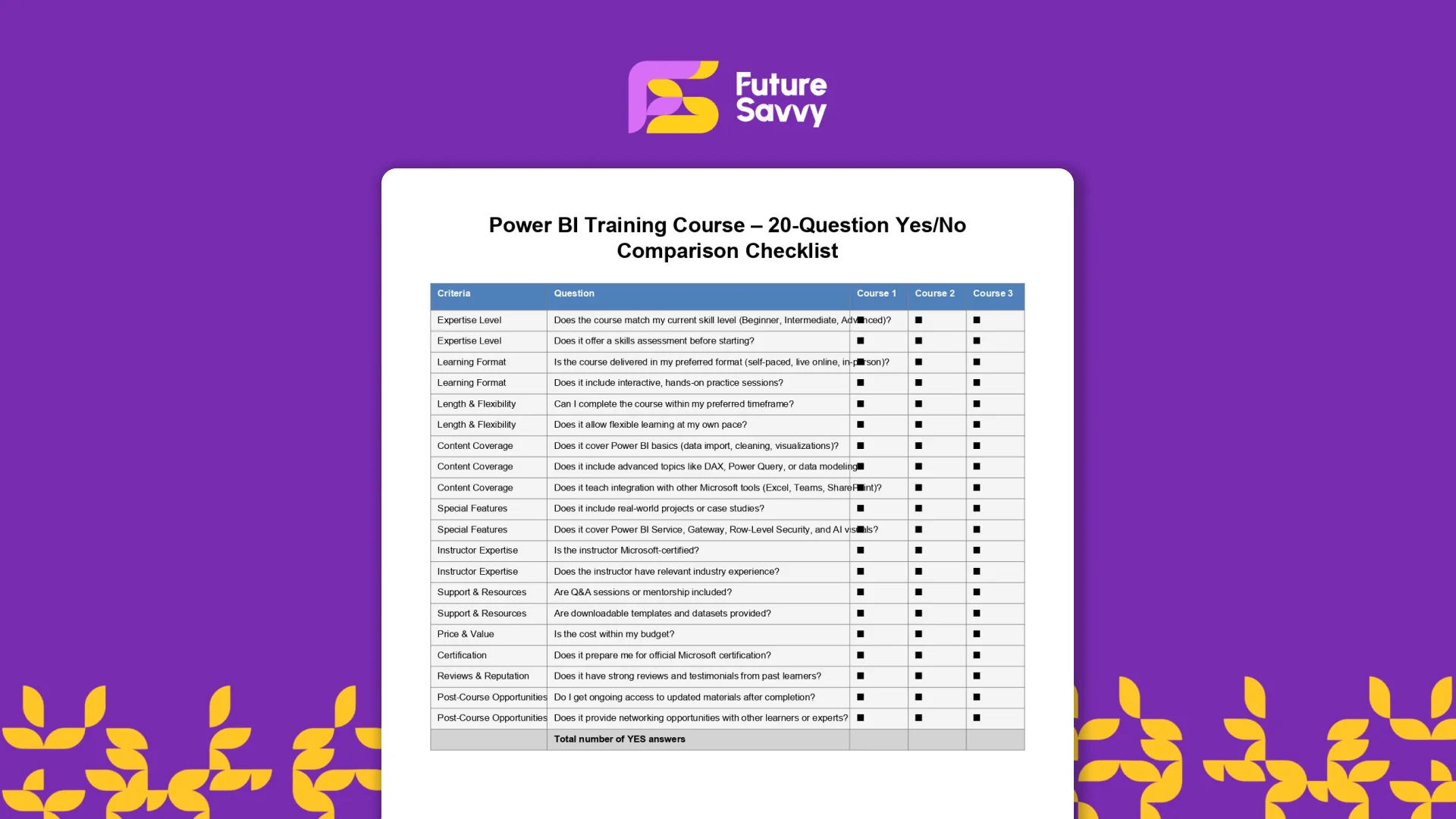
Power BI Training Course – 20-Question Comparison Checklist
The Power BI Training Course – 20 Questions Checklist is a practical, printable tool to compare Power BI courses across providers objectively. Use it to score curriculum quality, delivery format, hands-on practice, certification prep, and after-course support so you can choose with confidence.
 L&D Insights
Basic vs. Advanced SQL Training Courses: What is the difference?
The article explains what SQL training courses cover at basic and advanced levels, highlighting their shared focus on hands-on practice. It contrasts beginner courses that teach core querying and database concepts with advanced courses that tackle complex joins, window functions, CTEs, indexing, and performance. It outlines certifications, career paths, and why SQL remains a high-demand skill across roles like analysts, engineers, and developers. Finally, it offers criteria for choosing the right course and showcases instructor-led options from providers such as Future Savvy and others.
 L&D Insights
Literacy vs Digital Literacy: What Are the Differences?
Traditional reading-and-writing literacy has broadened into digital literacy—the ability to locate, evaluate, create, and communicate information safely and effectively through technology. The article traces this evolution from basic “computer literacy” of the 1990s to today’s multifaceted concept that spans information, media, and AI literacy. Digital skills now underpin social inclusion, workforce readiness, and democratic participation, while gaps in access, competence, and support exacerbate inequality.
Insights for modern teams
Stay ahead with our latest learning trends, tools, and success stories. Enter your email address below to receive updates from us.